
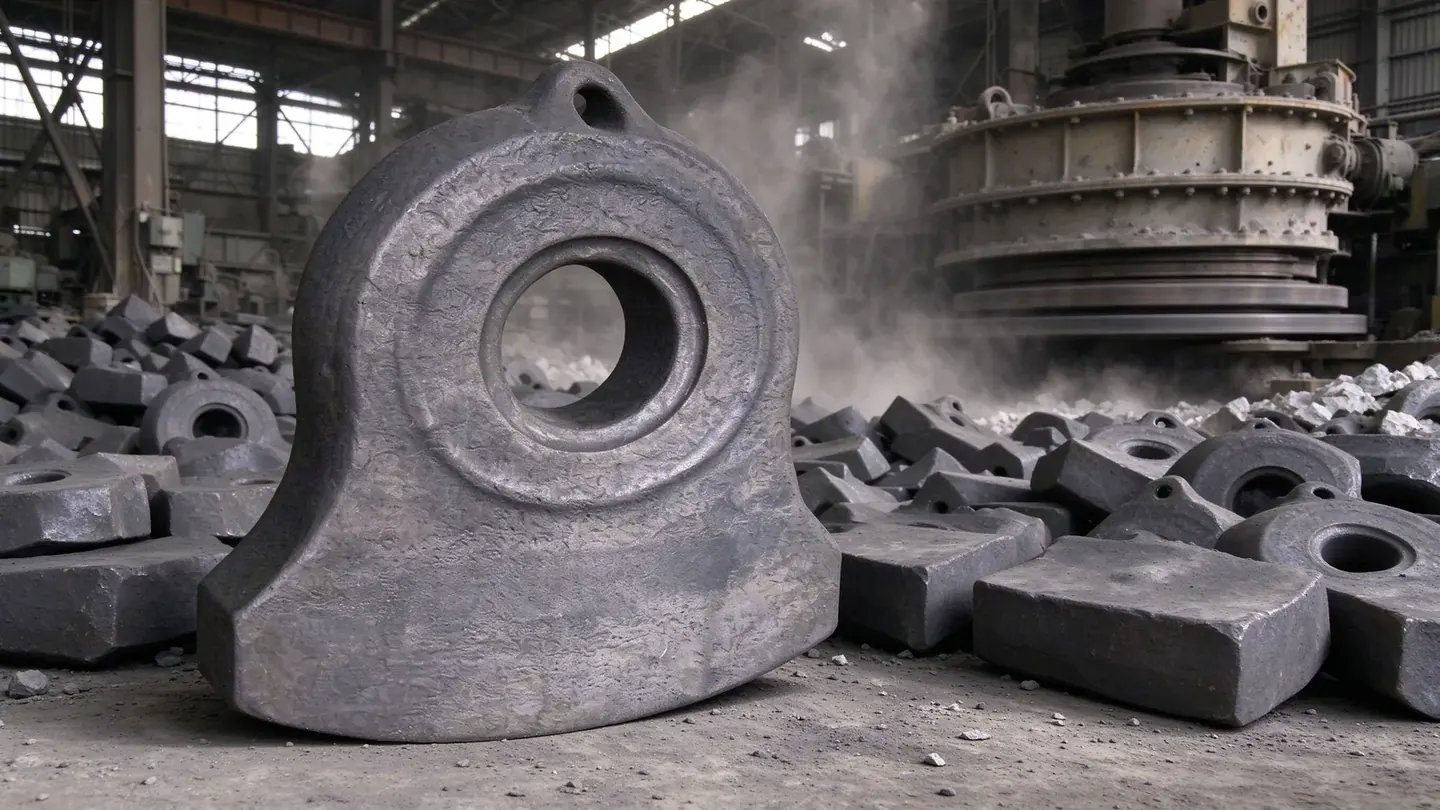
Wear Parts for Cement Plants and Quarries
From the primary crusher to the cement mill and the cooler line — cast wear parts matched to the position, the media and the failure mode, in manganese, high-chromium and chrome-moly grades.
The Plant Wears Differently at Every Stage
A cement line is usually discussed as one process, but the wear mechanisms along it have almost nothing in common. Limestone crushing is impact with a silica edge. Raw and cement milling is abrasion under a grinding charge. The kiln and cooler add heat, thermal cycling and oxidation to the picture. A single "wear resistant" grade applied across all of them is a compromise that shows up as short life in at least one position.
The practical consequence is that the specification has to travel with the position. The same foundry can cast the jaw plate, the mill liner and the cooler plate, but the alloy, the heat treatment and the inspection scope are different decisions for each.
DINGDAR casts in green sand, shell moulding, lost foam and investment, with heat treatment, machining and inspection in the same plant, so a mixed order for the crushing, milling and kiln-line positions is reviewed and released as one project rather than three unrelated purchases.
Where Wear Parts Sit on a Cement Line
Five stages account for most of the consumable spend.
| Stage | Typical parts | Grades usually specified | What decides life here |
|---|---|---|---|
| Quarry and limestone crushing | Jaw plates, blow bars, impact plates, hammer heads, apron and breaker plates | Mn18Cr2 for slabby blast feed; high-chromium iron (Cr15–Cr26) for abrasive, already-reduced feed | Limestone is soft but often silica-bearing. Wear here is a mix of impact and scratching, so the grade choice follows the feed gradation rather than the rock name. |
| Raw mill and cement mill | Shell liners, head and end liners, lifter bars, grate plates, diaphragm plates | Pearlitic chrome-moly steel for large sections; Mn18Cr2 where impact dominates; high-chromium iron in the fine chambers | A flattened lifter profile costs throughput long before the liner is worn through — the mill keeps drawing power while grinding less. |
| Kiln and preheater | Cast wear plates, chute and duct liners, chain-system components cast to drawing | Heat-resistant alloy steel grades to the plant specification | Hot, abrasive and often slightly reducing. Geometry and alloy are set by the drawing and the operating temperature, not by a catalogue number. |
| Clinker cooler | Grate plates, cast wear plates and side liners | Heat-resistant and abrasion-resistant grades, selected per position | Thermal cycling is the dominant failure mode, not abrasion. Cracking at the fixing points is the signal to review the alloy and the clamping, not just the plate thickness. |
| Conveying, chutes and silos | Chute liners, hopper liners, wear plates, impact beds | High-chromium iron for sliding abrasion; alloy steel where the plate is structural | The cheapest wear plate on the line is often the one that was specified from the material actually flowing — wet, sticky or free-flowing changes the answer. |
Parts for kiln and cooler positions are produced to the plant's drawing and alloy specification; the grade families and their behaviour are set out on the wear-part materials page.
Four Things That Decide Whether the Next Set Lasts
Read the failure, not just the wear
A plate worn thin in the middle is an abrasion problem. A plate cracked at the bolt holes or curled at the edge is a fixing, thermal or impact problem, and a harder alloy will make it worse.
Match the grade to the chamber
The coarse chamber of a mill and the fine chamber see different media and different energy. One grade across both is a compromise that usually costs throughput in one of them.
Keep the profile in the specification
Lifter height, face angle and plate thickness together decide how the charge behaves. A replacement that is dimensionally correct but profiled differently is a different part.
Document scope before production
Material certificate, hardness, dimensional report and visual inspection are agreed before casting, so the release documents match what the plant actually needs.
Cement & Aggregate Wear Parts FAQ
Can you match a cement plant OEM part number?
Which grade do you recommend for mill liners in cement grinding?
Do you cast heat-resistant parts for kiln and cooler positions?
How do you handle a part that fails early?
What documentation ships with a cement plant order?
Further reading: choosing between green sand and investment casting and which inspection records to request .
Send the Position, Not Just the Part Name
Tell us the stage, the equipment and how the last part failed — we confirm alloy, geometry and inspection scope and reply with technical feedback within 12–24 hours.