
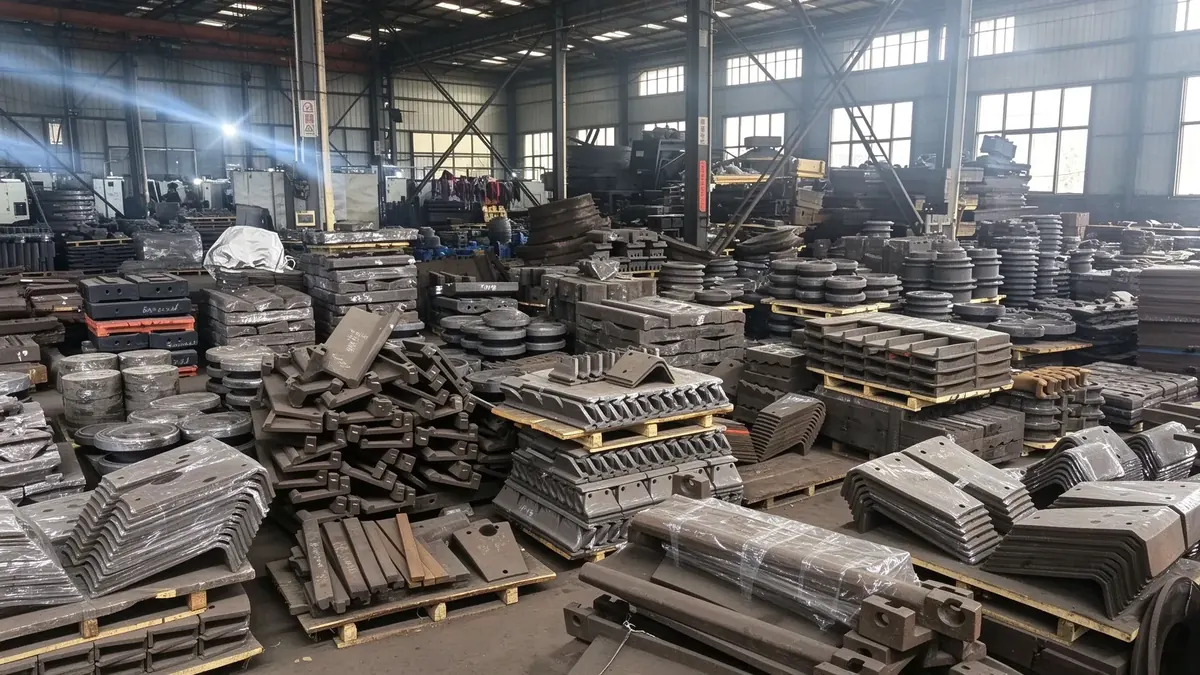
Direct answer: choose the liner from the duty, not from the material name
The right ball mill liner matches four operating facts: mill zone, grinding-media impact, feed abrasiveness and liner profile. Mn13 or Mn18Cr2 manganese steel is usually the starting point for high-impact shell, head and end-liner duty. Pearlitic chrome-moly steel or high-chromium cast iron becomes more relevant when sliding abrasion dominates and impact energy is controlled. Rubber or composite systems can be considered where lower weight, noise reduction or easier handling matters and the feed and temperature are compatible.
A material label alone is not enough. The same mill can need different materials at the feed end, shell and discharge end, and the selection can change as feed size, media size, throughput or liner profile changes.
What do ball mill liners do?
Ball mill liners perform two jobs: they protect the mill shell and heads from repeated impact and abrasive contact, and they control charge movement through lifter height, face angle, pitch and shell coverage. Shell liners work with lifter bars to lift and release the grinding media. Head and end liners protect the feed and discharge ends, where impact direction and slurry movement differ from the cylindrical shell. Grate plates in grate-discharge mills also influence pulp flow and retention.
This is why liner selection is not only a wear-resistance decision. A profile that lifts the charge too aggressively can increase impact and power demand; a profile that has worn too far can reduce the intended grinding action even when metal remains on the shell.
Step 1: identify the liner position and mill duty
Start by separating the order into shell liners and lifter bars, feed-end or head liners, discharge-end liners, and grate plates or pulp-lifter components where applicable. Then record the mill type and operating duty. A ball mill, rod mill, regrind mill and SAG-related application do not impose the same loading pattern. Rod mills generally use a more rolling charge and need a profile that avoids damaging or tangling the rods. Ball mills use a media charge whose size, volume and impact energy influence both profile and material selection.
Do not mix a new lifter profile with an old shell-plate arrangement without reviewing the complete set. Lifter height, angle and spacing work as a system; changing one element can change charge motion and the wear pattern of the others.
Step 2: separate impact wear from sliding abrasion
| Observed condition | Likely selection direction | What to verify |
|---|---|---|
| Large media, coarse feed, repeated impact or deformation | Mn13 or Mn18Cr2 manganese steel | Media diameter, charge volume, feed size and liner support |
| Smooth, progressive abrasion with controlled impact | Pearlitic chrome-moly or high-chrome alloy | Ore abrasiveness, mill speed, temperature and crack history |
| Lower-impact secondary grinding where handling weight matters | Rubber or composite option, if compatible | Media size, feed sharpness, temperature and fixing method |
| Cracking, loose bolts or broken sections | Review installation and loading before changing grade | Bolt preload, shell seat, tramp material and liner fit |
| Uneven end-only or one-sided wear | Review feed distribution and operating conditions | Pulp level, feed entry, mill alignment and charge distribution |
A harder grade is not automatically better. High-chromium iron can offer strong abrasion resistance, but it has less tolerance for heavy impact and tramp material than a tough manganese grade. Manganese may wear inefficiently if the application does not provide enough impact for work hardening.
Step 3: compare the main ball mill liner materials
Mn13 manganese steel
Mn13 is a common starting point for high-impact grinding duty. Its value is the combination of toughness and work hardening: the working surface can become harder under repeated impact while the core retains toughness. It is commonly considered for shell, head and end-liner applications where the charge is heavy or the feed is coarse. If the feed is fine and impact energy is low, the surface may not work harden as expected.
Mn18Cr2 manganese steel
Mn18Cr2 is considered when the application needs a manganese-family liner with higher initial hardness and strong impact tolerance. It can be relevant for larger mills, heavier media or harder feed, but the exact grade and heat-treatment requirements should be confirmed against the project specification and material certificate.
Pearlitic chrome-moly steel
Pearlitic chrome-moly steel is a low-alloy, heat-treated option used where wear is more abrasive and impact is moderate. It can hold a liner profile predictably and is often considered for rod-mill and ball-mill applications with controlled impact. Confirm the hardness range, section thickness, heat treatment, mill zone and history of cracking or breakage.
High-chromium cast iron
High-chromium cast iron is designed for high abrasion resistance. ASTM A532 is a relevant standard reference for abrasion-resistant cast irons used in mining, milling and earth-handling applications. High-chrome liners are most defensible where abrasion dominates and impact is controlled; they need caution with large balls, coarse feed, tramp material or high liner flexing.
Rubber and composite systems
Rubber and composite liners can be appropriate in selected secondary or fine-grinding duties. Possible advantages include lower handling weight, noise reduction and easier relining. Limits depend on media size, temperature, feed sharpness, chemical conditions and the fixing system. Compare them with steel on full operating cost, including liner life, relining time, handling equipment and downtime.
Step 4: inspect the worn liner before changing the material
Record residual thickness at agreed shell and head positions, lifter height and face-angle change, cracks or deformation, wear concentration near feed or discharge, current liner life in hours and tonnes milled, media size and charge volume, feed material and size, and any recent process changes.
If wear accelerated after a change in feed size, media size, throughput or mill speed, changing the alloy without correcting the condition may only hide the root cause. Photographs of the working face and mounting face are especially useful when a drawing is unavailable.
Step 5: confirm profile, fit and inspection scope
A liner set should be reviewed as matched geometry. Confirm the mill model, shell diameter and length, bolt pattern, liner section thickness, lifter arrangement, grate details and machining or fit requirements.
For a B2B order, define the inspection package before production. Depending on the application, this may include melt chemistry or a material certificate, heat-treatment record, hardness verification, dimensional report, visual inspection, non-destructive testing where justified and third-party inspection where required. DINGDAR reviews shell liners, lifter bars, head and end liners and grate plates against a drawing, sample, worn part or reference through the Ball Mill Liners page and technical contact process.
What should buyers send for a ball mill liner quotation?
A quote-ready information pack includes the mill model, shell diameter and length, liner position, current drawing or OEM part number, clear worn-liner photographs, media diameter and charge volume, feed material and size, current liner material and profile, service life, residual-thickness measurements if available, required quantity, delivery market and inspection documents. If a drawing is unavailable, a part number, machine model and clear photographs can still start the technical review.
Frequently asked questions
What is the best material for ball mill liners?
There is no single best material for every mill. Mn13 or Mn18Cr2 is generally considered for high-impact duty; pearlitic chrome-moly and high-chrome materials are considered when abrasion dominates and impact is controlled; rubber or composite options may suit selected lower-impact applications.
What are shell liners in a ball mill?
Shell liners protect the cylindrical mill shell and work with lifter bars to control how the grinding charge is lifted and released. Their profile affects charge movement, grinding action and wear distribution.
Are ball mill shell liners and head liners the same?
No. Shell liners protect the cylindrical barrel, while head or end liners protect the feed and discharge ends. They experience different loading and are normally specified as separate components within a matched liner set.
When should a mill use Mn18Cr2 instead of Mn13?
Mn18Cr2 may be considered when the mill has heavier media, harder feed, larger sections or a duty requiring higher initial hardness while retaining manganese-family toughness. The decision should be checked against the current wear pattern, media size and crack history.
When are high-chrome liners suitable?
High-chrome liners are most suitable when abrasive wear dominates and impact is controlled. They need caution in coarse-feed, large-media or tramp-material conditions because crack resistance may be more important than maximum hardness.
How can liner life be measured correctly?
Track operating hours and tonnes milled together with residual thickness or lifter height at agreed measurement points. Also record feed, media, throughput and mill-speed changes so comparisons reflect the operating condition.
Can ball mill liners be produced to a drawing or OEM part number?
Yes. A drawing, OEM reference, machine model or worn sample can be used to review geometry. The material, hardness, fit, inspection scope and quotation basis should be confirmed in writing before production.
Conclusion
Choose ball mill liners by matching profile, position, impact energy, abrasion, media and operating history. Mn13 and Mn18Cr2 are practical starting points for high-impact manganese duty; chrome-moly and high-chrome materials become more relevant as controlled abrasion increases; rubber and composite solutions belong to a narrower, application-specific range. The most useful comparison is cost per ton ground over the full liner life, including relining time and unplanned downtime.
Further reading: DINGDAR Ball Mill Liners, DINGDAR Ball Mill Liners: Materials and What Affects Liner Life, Bradken Mill Liner Solutions, FLSmidth Mill Liners, and ASTM A532/A532M Standard Specification for Abrasion-Resistant Cast Irons.