
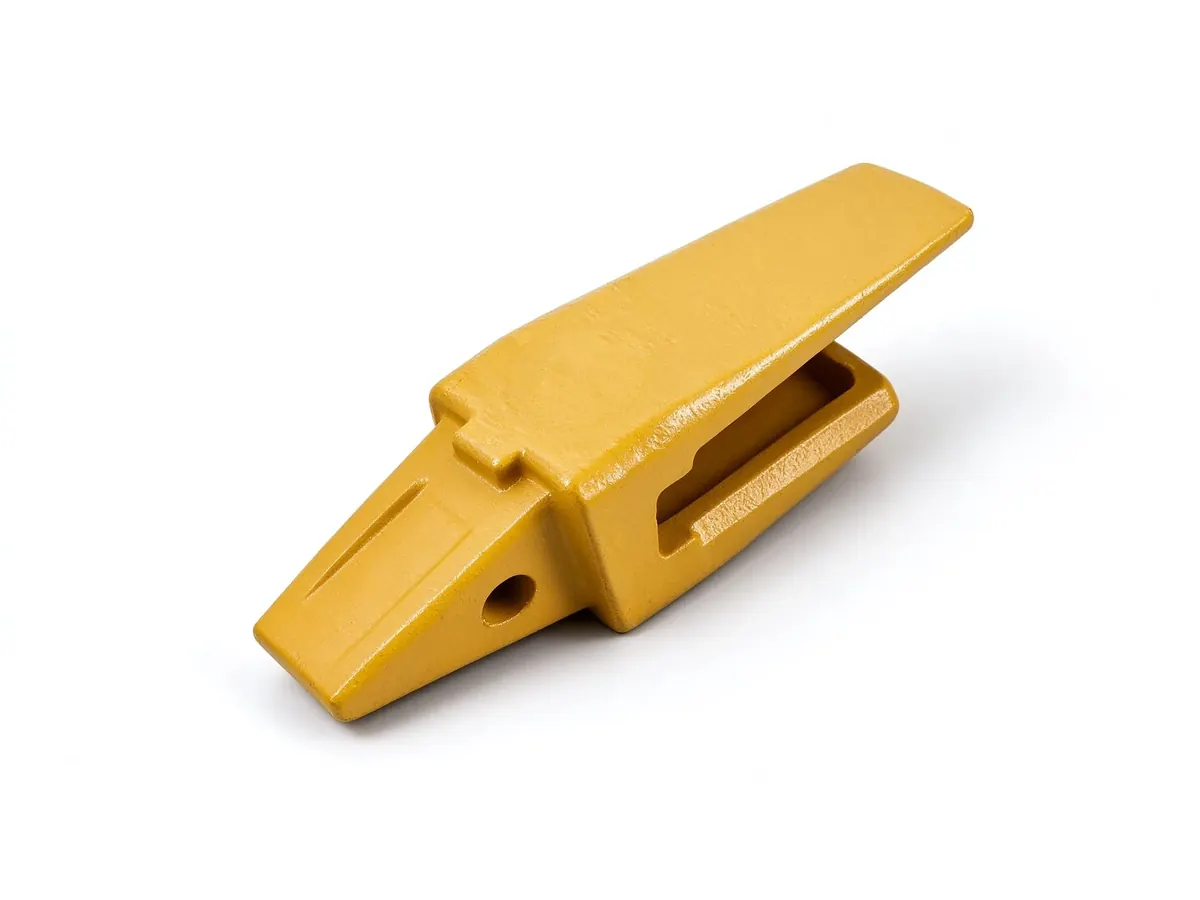
A bucket tooth and adapter should be ordered as a matched connection, not as two items that merely look similar. Before requesting a replacement, identify the machine and bucket, check the tooth-to-adapter interface and retaining system, and compare the old part's mounting geometry with a drawing, part number or clear photographs. Material selection comes after fit and working duty. This guide gives excavator and loader buyers a practical way to prepare that information without claiming that one tooth fits every bucket of the same machine model.
Why the machine model alone is not enough
An excavator model helps narrow a search, but it does not identify every bucket fitted to that machine. Buckets can be replaced or modified, and a fleet can contain different tooth systems even when the excavators have the same model designation. The tooth slides or seats onto an adapter; the adapter is attached to the bucket lip; and a pin or other retainer holds the replaceable tooth in place. If any one interface differs, an apparently close replacement may be difficult to install, loosen in service or fail to retain securely.
Record the machine make and exact model, then identify the bucket separately. Photograph the bucket lip and the existing adapter from the side and from the front. If a part number or casting mark is legible, capture the complete mark in a close-up rather than copying only its first characters. Note whether the required item is a tooth, an adapter, a retainer or a matched set. That distinction matters to purchasing: a supplier cannot safely assume that a request for “bucket teeth” includes pins or that an adapter will match a tooth from a different system.
Where the bucket has been repaired or its adapters have been replaced before, the visible parts are stronger evidence than an old machine purchase record. Treat the machine model as the starting reference; confirm compatibility against the actual assembly. DINGDAR's bucket teeth and adapters product page lists available tooth and adapter references, but a reference still needs to be checked against the bucket in service.
Check three interfaces before discussing the alloy
The first interface is tooth to adapter. Compare the internal shape of the tooth pocket with the adapter nose: the seating faces, top and bottom profile, width, insertion depth and the position of the retaining opening. A tooth that starts to slide on is not necessarily a fit. If it bottoms out on one point while leaving a gap elsewhere, loads concentrate rather than being carried by the intended contact faces. Ask the supplier to review clear photographs of both pieces together and separately; where possible, provide a dimensioned sketch or an unworn reference.
The second interface is the retaining system. Identify the pin or other retainer and its direction of insertion. Record the opening shape and location on both the tooth and the adapter, and show any lock, keeper or rubber element supplied with the current system. Do not substitute a pin simply because its diameter appears close: retention depends on the complete system and the condition of the mating parts. If the old retainer has failed or fallen out, state that explicitly and photograph the worn openings rather than hiding the damage in a general photo of the bucket.
The third interface is adapter to bucket lip. For an adapter replacement, document the bucket lip thickness, adapter position, mating faces and attachment design. Show the existing weld area or other fixing arrangement and any repair that changed the lip. A tooth-only replacement generally does not require redefining the lip connection, but a new adapter does. Welding method and acceptance requirements should be agreed for the specific part and site procedure; a material name on its own is not a welding instruction.
| Interface | Evidence to send | Question to resolve |
|---|---|---|
| Tooth to adapter | Both parts, side and front views, part marks, pocket and nose dimensions | Do the contact faces and insertion depth match? |
| Retaining system | Retainer, openings, lock details and insertion direction | Will the complete system secure this tooth to this adapter? |
| Adapter to bucket lip | Lip thickness, attachment area and repair history | Does the replacement adapter match the existing bucket connection? |
Measure an unworn reference where possible
Worn parts are useful for identification, but they can mislead if wear has removed the surfaces that locate the tooth. Separate original geometry from service damage in your notes. Measure overall tooth length and width, pocket opening, adapter nose width and relevant distances between locating faces. For the retaining system, record the position of the opening relative to a clearly named reference face rather than sending a single unlabelled diameter. Mark the units on every sketch and photograph; a tape measure or calliper in the frame helps only if the camera view is square enough to avoid perspective error.
If you have a new spare from the same bucket, compare it with the worn sample. If you have a current drawing, send its revision and identify which dimensions are critical to the fit. When neither is available, state which surfaces are worn or rebuilt so the supplier knows where a sample measurement cannot be treated as the design dimension. A short side-view video showing how the tooth engages the adapter can clarify more than an isolated close-up, but it should supplement rather than replace the part number and measurements.
Keep left, centre and right positions distinct when tooth shapes differ across a bucket. Record the quantity required for each position and whether adapters need replacement too. This prevents a purchase order for the right total quantity but the wrong mix of parts. A matched tooth, adapter and retainer set can simplify sourcing when the old components come from uncertain systems, provided the bucket-lip connection has first been confirmed.
Choose the material against the work, not the catalogue label
Once geometry and retention are clear, describe the application. Excavation in abrasive ground, quarry loading, demolition and ordinary earthmoving do not wear teeth in the same way. Give the working material, whether impact or abrasion is dominant, the current tooth life if recorded, and photographs showing how the previous teeth wore or broke. A worn point, a cracked shank and a retainer that repeatedly comes loose call for different reviews; changing alloy without checking the interface may repeat the same failure.
DINGDAR's existing product specification describes wear-grade alloy or manganese steel for teeth and adapters, with the grade matched to application. That statement is a review range, not a guarantee that a named grade is suitable for every bucket. Ask for the proposed grade, any required hardness or material record, and the dimensional checks that demonstrate fit. If the site has a particular acceptance standard, include it with the request so the quotation can identify the inspection scope before production rather than after the parts arrive.
An early technical review should not promise a fixed service-life gain. Tooth life also depends on bucket geometry, operating technique, ground condition and whether a worn adapter continues to support the tooth properly. Use the history of your own bucket as the comparison baseline. When parts have failed, keep the failed tooth and retainer long enough to photograph the contact surfaces and failure location; those observations are better evidence than a catalogue description such as “heavy duty.”
Send a quote-ready identification pack
You can begin a review without a complete engineering drawing. A strong first request includes the machine make and exact model; bucket photos; a legible tooth or adapter part number if present; separate images of the tooth, adapter nose, retainer and bucket lip; key measurements with units; the requested quantities by position; and the working material. If the previous set wore quickly or detached, add its service history and images of the failure. State whether you want teeth only, adapters only, retainers, or a matched set.
For an adapter order, add the lip dimensions and existing attachment details. For an OEM or drawing-based order, specify the current drawing revision and critical fit dimensions. For shipping and inspection planning, provide the destination market and the documents or tests that must accompany the order. The crusher wear parts quotation checklist offers a broader way to organize part references, quantities and acceptance requirements, while the inspection-records guide explains how to define material and dimensional evidence before production.
The decision sequence is simple: identify the actual tooth system, verify all three interfaces, examine the worn part, then confirm material and inspection scope. If you have only a machine model and photos, that is enough to start a review—but not enough to assert a final fit. Send the available evidence through DINGDAR's contact form and ask the team to state any unresolved dimensions before confirming the quotation.