
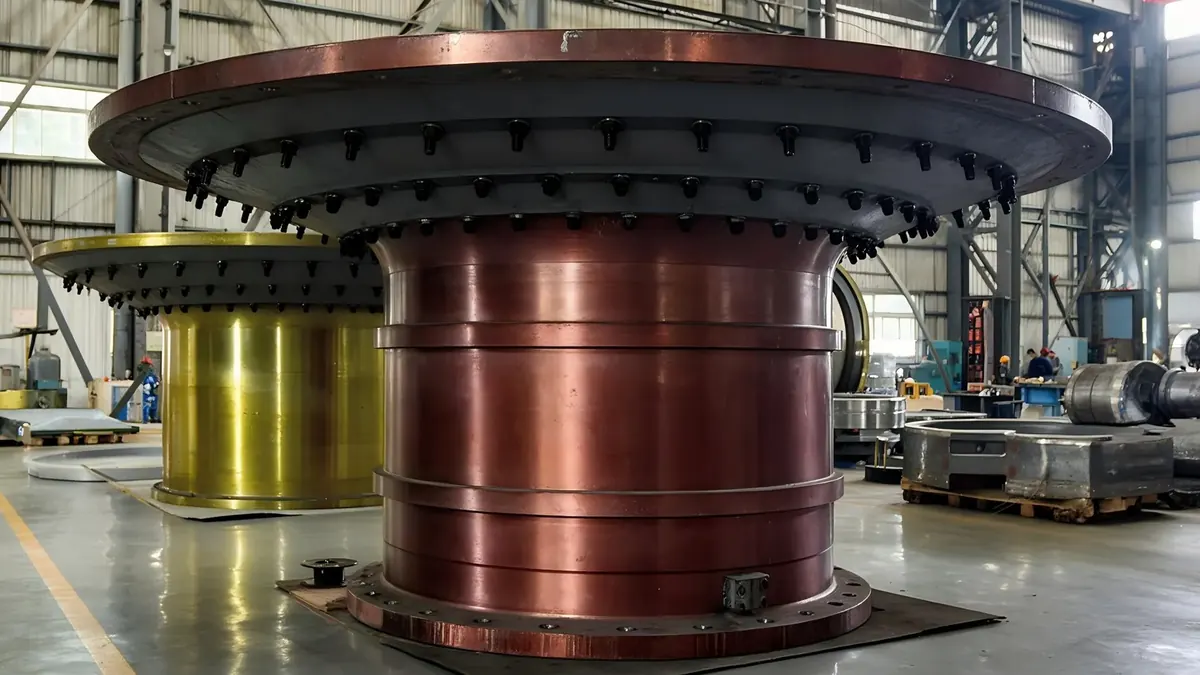
Direct answer: A cone crusher liner set is two castings: the mantle, the moving liner on the gyrating head, and the concave or bowl liner, the stationary ring on the frame. Brands do not agree on the stationary name — some use concave for the upper ring and bowl liner for a separate lower component, others use both names for the same casting — so a liner is identified by position, by chamber (coarse, medium or fine) and by crusher model, then confirmed with part number, key dimensions and photos of the worn part. High-manganese steel in the Mn13 and Mn18 families, the ASTM A128 grades, is the industry baseline; a high-chromium iron in roughly the Cr15–Cr26 range takes over where the feed is fine and wear is dominated by sliding abrasion rather than impact.
Mantle, concave or bowl liner: what each name means
Terminology is where many inquiries go wrong before they even start. The moving liner is called the mantle on virtually every brand. The stationary ring is where names split: some manufacturers call it the concave, others the bowl liner, and a few use both names for different parts of the same assembly.
| Part | Position | Names in use | Function |
|---|---|---|---|
| Mantle | Moving liner on the gyrating head | Mantle, universally | Crushes on the moving side and, with the stationary ring, forms the chamber |
| Concave | Stationary upper ring | Concave; bowl liner on some ranges | Crushes on the fixed side of the chamber |
| Bowl liner | Stationary lower ring, where it is a separate component | Bowl liner; also used loosely for the whole stationary ring | Closes the discharge end of the chamber |
In one well-known range the concave is the upper ring and the bowl liner is a separate lower component; in another brand the two terms describe the same casting. Quoting "the part on the left when you stand facing the feed" is surprisingly common in real inquiries. The reliable way to describe a liner is by position (moving or stationary), by chamber (coarse, medium or fine) and by the crusher model and feed opening — that combination removes almost all ambiguity.
Why the same crusher can run different liners
A cone crusher crushes by compression. The mantle is mounted on the main shaft, which is carried in an eccentric that makes the head gyrate inside the fixed concave ring; the crushing chamber between the two surfaces narrows toward the discharge end, and rock is broken as it is squeezed between the moving and stationary liners.
Because the liner profile defines the shape of that chamber, the liner is doing two jobs at once: it protects the structural steel and it sets the reduction ratio, the throughput and the product shape. A coarse-profile liner opens the chamber for high throughput with a coarser product; a fine profile closes the chamber for better reduction and shape at lower capacity. The same crusher can therefore legitimately run different liners, and that is the first reason a machine model alone cannot identify a part.
Four sources of evidence that identify a liner
The fastest identifier is still the part number, normally cast into the back of the liner or stamped on a tag. But a part number is only as trustworthy as the drawing behind it. In the aftermarket, liners are frequently repoured: a supplier takes an original pattern or scans a used liner, and the result can be close in outline yet different in wear-band thickness, bolt-hole spacing or chamber geometry. The same part number from two suppliers can produce different life and different product.
Identification should therefore combine four sources of evidence: the part number, the crusher brand and model from the nameplate, a set of key dimensions, and photographs of the worn liner. The dimension set that matters for a cone liner is short, and it is the check that catches a drifted pattern before production rather than after.
| Measurement | Where it is taken | What it catches |
|---|---|---|
| Top inner diameter | Feed end of the liner | Chamber opening and profile drift |
| Bottom inner diameter | Discharge end | Reduction ratio and setting range |
| Overall height | Working face to mounting face | A worn part reproduced short |
| Wear-band thickness | Thickest section of the working face | A pattern cut from a worn liner coming out thin |
| Bolt pattern | Mounting face | Hole spacing that will not seat |
Photographs: three shots that do most of the work
Photographs deserve a short method of their own. Three shots are usually enough: the wear face showing the profile, the back or mounting face, and a close view of the worn profile edge.
The value of the photos goes beyond identification. The shape of the wear tells the material reviewer how the liner was loaded — whether the feed was choked, whether the liner was fed unevenly, whether tramp metal passed through. A liner that wears evenly to the profile is doing its job; one that shows a deep groove on one side or a hollowed band usually points to a feed or setting problem that a different material will not fix.
Material baseline: the Mn13 and Mn18 families
Material is the second decision, and for cone liners the industry baseline is high-manganese steel. The grades most commonly specified fall in the Mn13 and Mn18 families, corresponding to the classic austenitic manganese steels covered by ASTM A128. Their behaviour is distinctive: under the repeated impact of a cone chamber, the working surface work-hardens — the outer layer compresses into a skin several times harder than the as-cast metal while the core remains tough — so the same liner resists both the blow and the sliding abrasion that follow it.
| Duty | Grade | Why it is specified |
|---|---|---|
| Normal ore and aggregate duty | Mn13 | Work-hardens under the chamber's repeated impact |
| Harder feed, large liners that flex under load | Mn18, often as Mn18Cr2 | Higher manganese with a chromium addition for as-cast hardness |
| Fine feed, low impact, sliding abrasion dominant | High-chromium iron, roughly Cr15–Cr26 | Starts hard and holds hardness; needs a machine that tolerates brittleness |
Mn13 suits normal ore and aggregate duty; Mn18, sometimes refined with a chromium addition in the Mn18Cr2 form, is chosen for harder feed and for large liners that flex under load. What matters for the buyer is that the grade is selected against actual working conditions, because the same part number can justify different grades in different pits.
When chrome beats manganese
Manganese is not the only answer. Where the feed is fine, the impact energy is low, and the wear mechanism is dominated by sliding abrasion rather than impact, a manganese liner may fail to work-harden properly and can wear like a softer steel.
In those conditions the alternative is a high-chromium white iron or an alloy steel with higher as-cast hardness. Chromium-alloy liners in the approximate Cr15 to Cr26 range start hard and hold their hardness, which extends life dramatically in abrasive fines; the trade-off is lower toughness, so they are reserved for applications where the material and the machine can tolerate the brittleness. A liner choice therefore needs to know the feed size, rock type, closed-side setting and the failure pattern of the previous liner — the same information that identifies the part in the first place.
What the wear pattern tells you
The wear pattern itself is worth reading before it is written off as a material fault.
| Pattern | Likely cause | What to do |
|---|---|---|
| Even wear to the profile | Liner performing to design | Replace on the measured cycle |
| V-shaped groove | Feed segregation or uneven feed spread | Fix the feed, not the material |
| Broken or cracked edge | Oversized feed or tramp metal | Check feed size and tramp protection |
| Cracking around the bolt holes | Liner loose in its seat, or bolts not preloaded correctly | Check seating and bolt preload |
Because these patterns have different causes, the fastest route to longer liner life is usually to send the foundry a photo of the failed part with the running hours — the diagnosis comes back with the replacement, not after it.
Pattern, tooling and why unit price moves with quantity
The tooling question deserves a direct answer because it is where liner pricing is decided. A cone liner is cast on a pattern or, in the aftermarket, frequently on a pattern cut from a 3D scan of a used liner. The pattern cost is real and it is paid once; it is amortised across the quantity you order, which is why the same liner gets a different unit price at five pieces than at fifty.
When a supplier quotes a liner at a very low price, it is worth asking what the pattern was made from and what the dimensional check against the original part was — because a pattern cut from a worn liner inherits the wear of that liner, and the new casting will come out thinner in the exact zone that already wore out. That single question separates casters who reproduce a worn part from casters who reproduce the drawing.
Inspection records that ship with the liners
Inspection records complete the liner order. For a cone liner the meaningful evidence is the melt chemistry — the manganese content that confirms the Mn13 or Mn18 grade actually poured — a hardness check, and a dimensional report on the critical faces and bolt-hole pattern.
Large liners with heavy service are sometimes specified with ultrasonic or magnetic-particle testing on the working section, and third-party inspection can be added where the buyer or the end customer requires independent verification. Each item has a cost, so the inspection scope should match the part and the application rather than being applied uniformly; agreeing it in the review means the records ship with the liners instead of being requested after arrival.
Seating: the failure mode material cannot fix
One more operating point explains a large share of premature liner failures. A cone liner is only as good as its seating: the mantle and the stationary liner are held against machined seats, and a liner that is not fully seated, or that was ordered without the matching set, moves under load, hammers against its seat and cracks from the back regardless of material.
The correct part number with a loose fit fails faster than the wrong part number seated properly. That is why the identification step — dimensions, photos and the machine model — is not administrative paperwork; it is the first line of defence on liner life, and it is free to provide at the start of an inquiry.
Summary
The short version: the mantle moves and the stationary ring may be called either concave or bowl liner, so describe a liner by position, chamber and machine before quoting a part number; Mn13 and Mn18 are the baseline grades and chrome only wins where impact is low; and the wear pattern, not the price list, says whether the last liner was the right one. Buyers who manage liner stocks well treat the cone liner as a system: the mantle and the stationary liner wear at different rates and are rarely changed together, so ordering them in matched sets while keeping one set in stock shortens the change-out window.
For a quotation, send:
- The part number, or the crusher brand and model from the nameplate.
- The chamber type — coarse, medium or fine.
- The five measurements in the table above, or photos of the worn liner.
- The feed size, rock type and closed-side setting.
- The current liner life in hours, how it failed, the quantity and the delivery market.
Tooling, heat treatment and, where specified, machining all sit inside the lead time, so the identity and material decision made today decides the delivery date weeks later. The liners we cast are set out on the cone crusher wear parts page; to send a part for review use the quotation checklist, the contact form, email to [email protected] or WhatsApp. The project team confirms identity, chamber profile and material within 12–24 hours and quotes on that confirmed basis.